-
Corn Seed Production
Our Processes ensure the Highest Seed Quality
KWS is a global seed producer. We attach great importance to producing seeds of the highest quality. The path from planning through field multiplication and seed conditioning to delivery is therefore subject to the highest standards.
The whole process, starting from planning until the delivery of the final bags, takes over two years. Have a look at each individual step and find out what are the crucial points in each and challenges in each process and how they contribute to the highest seed quality. But first, how do we define quality?
How do we define quality?
Inner Quality – Key Criteria
The following quality criteria are continuously monitored to ensure the highest seed quality:
- Genetic purity: The seed is varietally pure.
- High germination rate: A minimum of 90% normal seedlings under optimal conditions must germinate according to legal requirements.
- High vigor: Highest possible percentage of normal seedlings under challenging conditions
We would like to point out that KWS exceeds these legal standards in meeting quality criteria for corn seeds.
Outer Quality – The Most Important Criteria
- Technical purity: The seed must be free from impurities.
- Uniform size and thousand kernel weight: These enable consistent singulation during sowing.
- Highest treatment quality: Each seed must carry the prescribed amount of active ingredients.
- Optimal, low moisture content: Ensures good storability.
Steps involved in KWS's corn seed production
Planning
Today, nearly all corn varieties grown are hybrids. Their popularity comes from clear benefits: higher yields, stronger plants, and more consistent results in the field.
Producing a hybrid involves crossing two specific parent lines. Since the seed for these parent lines must be available well in advance, planning for hybrid production starts long before the seeds are sown.
To ensure everything runs smoothly, KWS brings together key information early in the process:
- Insights from research and breeding
- The company’s strategic direction
- Production conditions and location-specific factors
- Sales forecasts from different markets
This coordinated approach helps ensure that hybrid maize seed production is well-prepared and aligned with future needs.

Sowing and Field Multiplication
To grow top-quality hybrid corn seed, the selection of the right locations is crucial. That’s why field multiplication takes place only in the most favorable regions of Europe. We can find these those mainly between 44° and 48° northern latitude. These areas offer ideal climatic conditions for successful seed multiplication like sufficient day temperatures and no frost during the harvest time.
Corn is a unique plant because it grows both male and female flowers on the same stalk. To produce hybrid corn, pollen from the male parts needs to fertilize the female ones. That’s why we plant them side by side in a carefully planned pattern.
Timing is everything! Since male flowers usually appear before the female ones, we stagger the sowing. First, we plant the female rows. As soon as they emerge, we sow the first male rows. When those emerge, we plant the next male rows and so on. This way, the male plants are in full bloom just as the female plants are ready to receive the pollen.

Detasseling
When it comes to producing top-quality hybrid corn, precision doesn’t stop at sowing. It continues right through the growing season. One of the most important steps in this process is detasseling.
Before the female plants begin to show their tassels and release any pollen, those tassels need to be removed. This step is called detasseling, and it’s essential for keeping the seed genetically pure. The tassels from the female plants are pulled out, because we want only the pollen from the selected male plants to fertilize the female ones.
To make this work, the first male rows are timed to flower just before the female plants are ready. That early pollen acts like a shield, protecting the crop from unwanted cross-pollination and ensuring the seed stays true to its hybrid potential.
Detasseling is done either by hand or with machines, carefully removing the top part of the female plants. And because not all plants grow at the same pace and mechanical processes are not perfect, mechanical detasseling is done twice and detasseling by hand up to ten times in the fields.

Harvesting
From mid-August onward — depending on the region and the variety — the harvest of the corn seed starts.
It usually begins when the cobs reach about 38% moisture. At first the early-maturing types are harvest followed by the later-maturing ones. The harvest stretches over several weeks, and timing is crucial: everything needs to be finsihed up before the first frost hits.
Instead of regular combines, we use special machines called ear corn pickers. These harvest the whole cobs. Afterwards the cobs are loaded on trailers and transported to the pocessing plants. Here they are further processed untill they are ready to be delivered to farmers and dealers.

Husking, Sorting and Drying
Once the ear corn reaches the seed plant, it’s time for the final steps that make all the difference in seed quality.
First up: husking. The husks are removed using specialized machines with counter-rotating rolls that gently strip the husks from the cobs in a fast, clean, and efficient way.
Then, the de-husked cobs head to the sorting tables. Here, every batch is carefully inspected. Cobs that didn’t develop properly or show signs of mold are sorted out by hand. Any off-types are removed too. The sorting table constitues the last checkpoint to ensure the genetic purity of your seed.
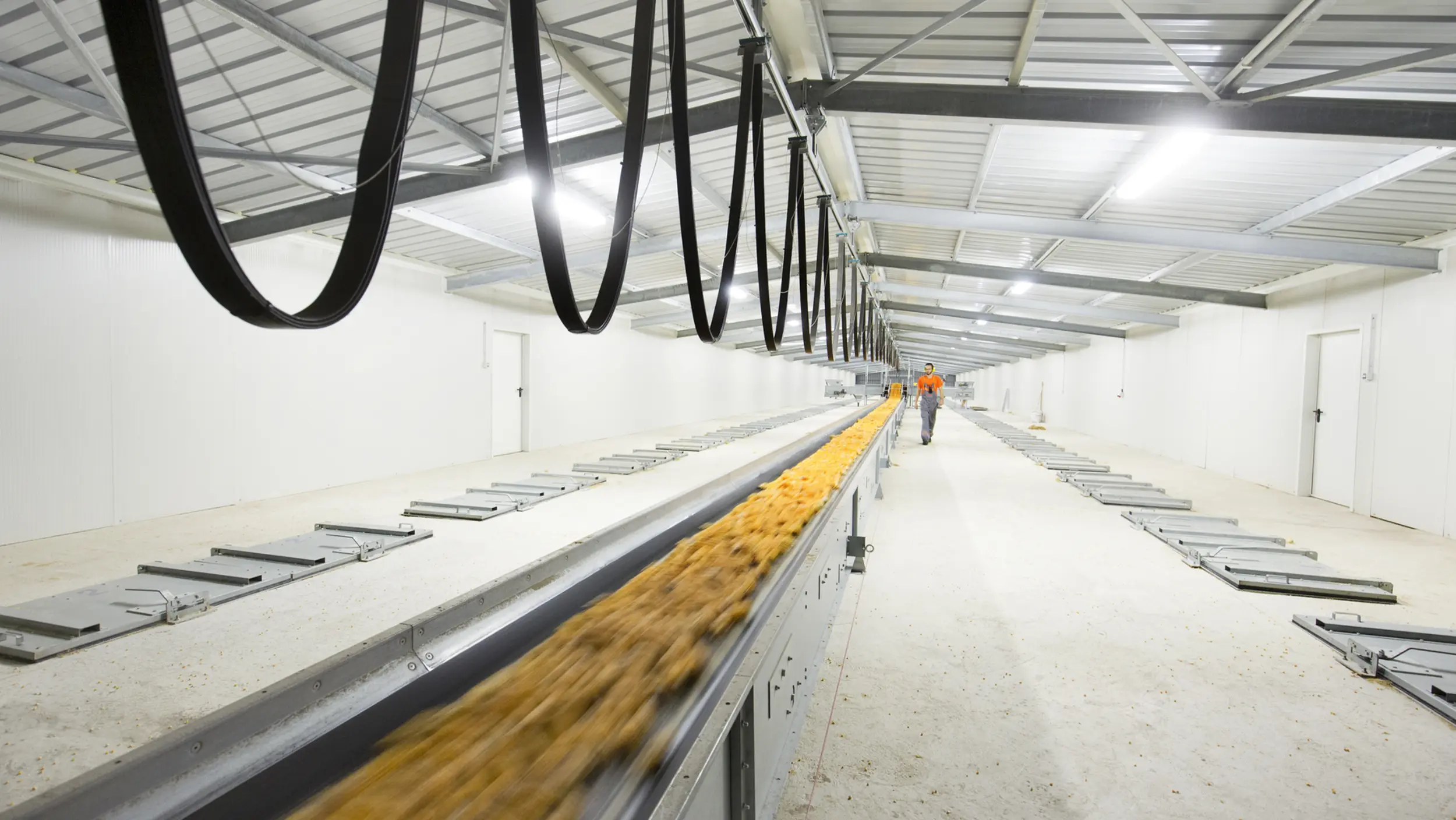
Next, it’s off to the drying houses. The ear corn is dried slowly and gently with warm air. The temperature has a maxium of 38°C. This protects the seed’s vitality while reducing moisture to a level of 14%. Depending on the weather and the initial moisture content, drying can take several days. However, it’s worth it as the gentle drying process ensures maintaining an excellent seed quality.

Treatment and Bagging
To give young seedlings the best possible start, KWS invests heavily in innovative seed treatments. Under the umbrella brand INITIO, these treatments are designed to protect and strengthen the plant from day one. With pinpoint accuracy, they support healthy growth and strong development from the moment the seed is planted in the soil.
The final steps are the application of the treatment and the preparation for the seed delivery. After nearly two years of careful cultivation, selection, and refinement, the hybrid seeds are ready to be bagged and sent to retailers and farmers.
At KWS, quality isn’t just a promise, it’s a principle. Every step of the process exceeds legal standards, because we believe farmers deserve nothing less than the best.

Corn Seed Production Quiz
Discover more


Behind each hybrid stands a team committed to your success—from agronomic advice to tailored support in the field. We are happy to help you!
Your contact partner
